

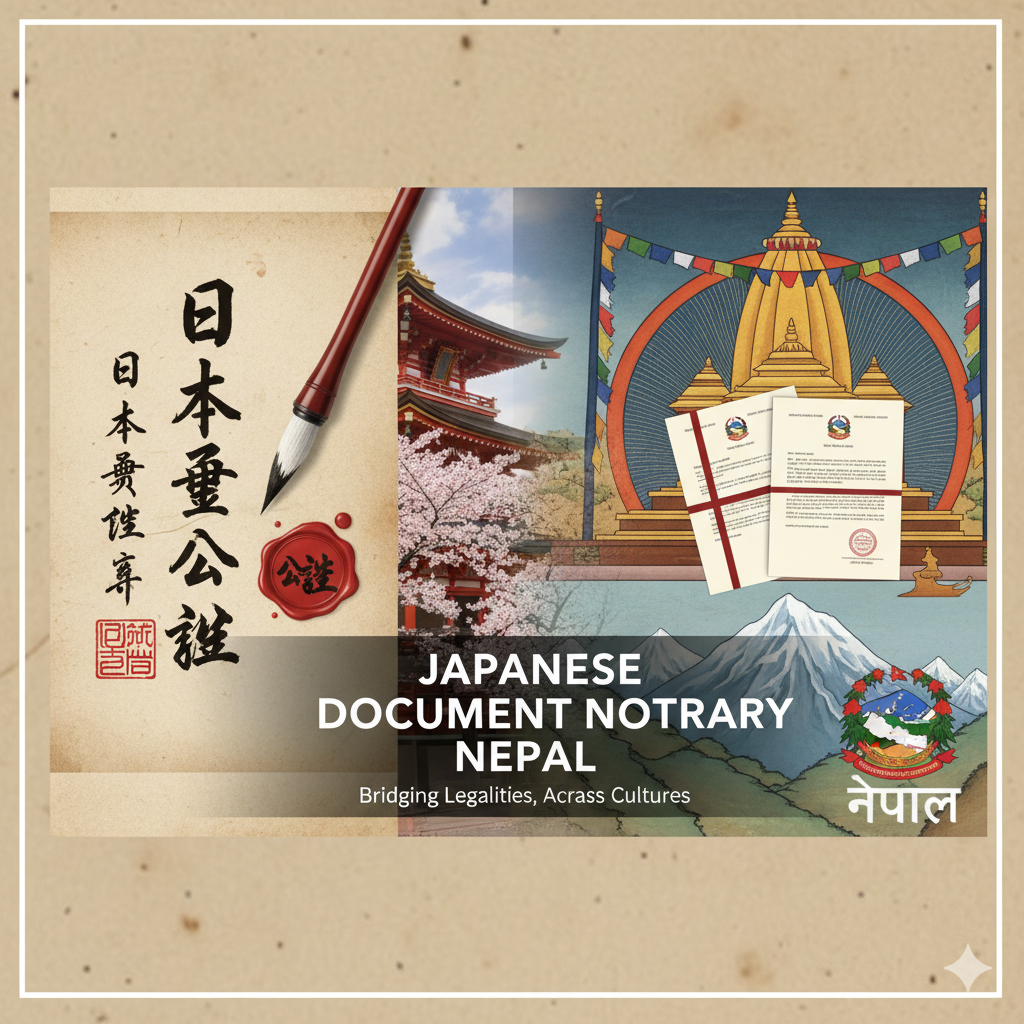
Japanese Document Notary Nepal
Japanese Document Notary Nepal: Complete Guide to Authentication Services
What is Japanese Document Notary in Nepal?
Japanese document notary Nepal refers to the legal process of authenticating Japanese-language documents for use in Nepal or Nepalese documents for use in Japan. This specialized service involves verification of document authenticity, translation certification, and official stamping by authorized notary publics and government agencies.
When Japanese documents need to be legally recognized in Nepal, they must undergo a specific authentication process. This procedure ensures that documents issued in Japan will be accepted by Nepalese authorities for various purposes including business transactions, educational recognition, immigration procedures, and legal matters.
The Japanese document notary Nepal process typically involves multiple steps including notarization by a certified notary public, authentication by the Ministry of Foreign Affairs (MOFA), and sometimes additional verification by the Embassy of Japan in Kathmandu.
Types of Japanese Documents Requiring Notarization
Various Japanese documents may require notarization when used in Nepal, including:
- Educational certificates: Degrees, diplomas, and academic transcripts
- Legal documents: Power of attorney, contracts, and agreements
- Personal documents: Birth certificates, marriage certificates, and divorce decrees
- Business documents: Company registration certificates, articles of incorporation, and financial statements
- Medical documents: Health certificates and medical reports
- Immigration documents: Visas, residency permits, and work authorizations
Each document type may have specific requirements for the Japanese document notary Nepal process, depending on its intended use in Nepal.
Why Japanese Documents Require Notarization in Nepal
Japanese document notary Nepal services are essential for several important reasons. When documents cross international borders between Japan and Nepal, they must be verified to ensure their authenticity and legal validity in the destination country.
The primary reasons Japanese documents require notarization in Nepal include:
- Legal recognition: Nepalese authorities need assurance that Japanese documents are authentic and legally valid
- Prevention of fraud: Notarization helps prevent the use of falsified or altered documents
- International compliance: The process ensures compliance with both Japanese and Nepalese legal requirements
- Official acceptance: Notarized documents are more likely to be accepted by government agencies, educational institutions, and businesses
According to Nepal's Notary Public Act, 2063 (2006), documents originating from foreign countries must undergo proper authentication to be legally recognized within Nepal. This legal framework establishes the requirements for Japanese document notary Nepal services.
Legal Framework Governing Japanese Document Notarization
The Japanese document notary Nepal process is governed by several legal provisions:
- Notary Public Act, 2063 (2006): Establishes the role and authority of notary publics in Nepal
- Notary Public Regulations, 2064 (2007): Provides detailed procedures for document authentication
- Ministry of Foreign Affairs Directives: Outlines specific requirements for foreign document legalization
- Nepal-Japan Bilateral Agreements: Any existing agreements affecting document recognition between the two countries
These legal frameworks ensure that Japanese document notary Nepal services meet established standards for authenticity and legal validity.
Where to Find Japanese Document Notary Services in Nepal
Japanese document notary Nepal services are available through several channels. Finding the right service provider is crucial for ensuring proper authentication of your Japanese documents.
The primary locations where you can access Japanese document notary Nepal services include:
- Notary Public Offices: Certified notary publics authorized to authenticate foreign documents
- Ministry of Foreign Affairs (MOFA): Located in Singha Durbar, Kathmandu, responsible for final authentication
- Embassy of Japan in Kathmandu: For certain document types requiring embassy verification
- Specialized Legal Service Providers: Law firms and document authentication agencies with expertise in Japanese documents
- Certified Translation Services: Providers offering Japanese-Nepali translation with notarization
Recommended Japanese Document Notary Service Providers in Kathmandu
| Service Provider | Location | Specialization | Contact Information |
|---|---|---|---|
| Kathmandu Notary Public Center | Thamel, Kathmandu | General document notarization | 01-xxxxxxx |
| Japan-Nepal Legal Services | Lazimpat, Kathmandu | Japanese document specialization | 01-xxxxxxx |
| MOFA Authentication Office | Singha Durbar, Kathmandu | Government authentication | 01-xxxxxxx |
| Embassy of Japan | Lainchaur, Kathmandu | Embassy verification | 01-xxxxxxx |
| Certified Translation Hub | New Baneshwor, Kathmandu | Translation with notarization | 01-xxxxxxx |
When selecting a Japanese document notary Nepal service provider, consider their experience with Japanese documents, processing times, and customer reviews.
How to Notarize Japanese Documents in Nepal
The Japanese document notary Nepal process follows a specific sequence of steps. Understanding this procedure will help ensure your documents are properly authenticated without unnecessary delays.
Step-by-Step Guide to Japanese Document Notarization
-
Document Preparation
- Ensure the Japanese document is complete and accurate
- Obtain any required supporting documentation
- Make clear photocopies of all documents
-
Translation (if required)
- Find a certified Japanese-Nepali translator
- Have the document professionally translated
- Obtain a translation certificate from the translator
-
Initial Notarization
- Visit a certified notary public with your documents
- Present original documents and valid identification
- Sign the documents in the presence of the notary
- Receive the notary's official stamp and signature
-
Ministry of Foreign Affairs Authentication
- Submit notarized documents to MOFA
- Pay the required authentication fees
- Wait for processing (typically 2-5 business days)
- Collect authenticated documents
-
Embassy Verification (if required)
- Submit MOFA-authenticated documents to the Embassy of Japan
- Complete any additional embassy-specific requirements
- Pay embassy verification fees
- Collect fully verified documents
-
Final Verification
- Confirm all necessary stamps and signatures are present
- Make copies for your records
- Safely store the original authenticated documents
Common Challenges in the Japanese Document Notary Process
Several challenges may arise during the Japanese document notary Nepal process:
- Translation accuracy: Poor translations can lead to rejection
- Incomplete documentation: Missing supporting documents can cause delays
- Improper formatting: Documents not meeting specific formatting requirements
- Signature inconsistencies: Signatures that don't match official records
- Expired documents: Documents that have exceeded their validity period
To avoid these issues, work with experienced Japanese document notary Nepal service providers who can guide you through the process.
Cost and Timeline for Japanese Document Notarization in Nepal
The Japanese document notary Nepal process involves various costs and timelines that vary depending on document type, service provider, and processing speed.
Cost Breakdown for Japanese Document Notarization
| Service | Average Cost (NPR) | Processing Time |
|---|---|---|
| Notary Public Services | 500-2,000 per document | Same day |
| Certified Translation | 1,000-5,000 per page | 1-3 days |
| MOFA Authentication | 500-1,500 per document | 2-5 business days |
| Embassy Verification | 2,000-8,000 per document | 3-7 business days |
| Expedited Processing | Additional 50-100% | 50-70% faster |
Factors Affecting Cost and Timeline
Several factors influence the cost and timeline of Japanese document notary Nepal services:
- Document complexity: More complex documents require more time and expertise
- Translation requirements: Documents needing translation incur additional costs
- Processing speed: Expedited services cost more but reduce waiting time
- Service provider: Different providers have varying fee structures
- Government fees: Official fees may change periodically
- Additional verification: Some documents require extra authentication steps
When budgeting for Japanese document notary Nepal services, consider all potential costs and allow buffer time for unexpected delays.
Required Documents for Japanese Document Notarization
Proper documentation is essential for successful Japanese document notary Nepal services. Having all required documents prepared in advance will streamline the authentication process.
Essential Documents for the Notarization Process
- Original Japanese document: The primary document requiring notarization
- Valid identification: Passport, citizenship certificate, or government-issued ID
- Supporting documentation: Any additional documents referenced in the primary document
- Translation certificate: If translation is required, a certificate from the translator
- Authorization letter: If someone else is submitting documents on your behalf
- Application forms: Specific forms required by MOFA or the Embassy of Japan
- Payment receipts: Proof of fee payments for various authentication steps
Special Requirements for Different Document Types
| Document Type | Special Requirements |
|---|---|
| Educational Certificates | Transcript verification, institution contact information |
| Legal Documents | Witness statements, original signatures, legal representative authorization |
| Personal Documents | Relationship proof, family registration certificates |
| Business Documents | Company registration proof, authorized signatory identification |
| Medical Documents | Doctor's certification, hospital letterhead, official stamps |
Understanding these specific requirements for Japanese document notary Nepal services will help ensure your documents are processed without complications.
Recent Updates to Japanese Document Notarization Procedures
The Japanese document notary Nepal process has evolved in recent years, with several important updates affecting how documents are authenticated.
Digital Authentication Options
Recent developments have introduced digital elements to the Japanese document notary Nepal process:
- Online appointment systems: Many notary offices now offer online scheduling
- Digital verification portals: Some documents can be verified through online systems
- Electronic notarization: Limited digital notarization options for certain document types
- Document tracking systems: Online tracking of authentication status
These digital innovations have made the Japanese document notary Nepal process more efficient and transparent.
Procedural Changes Due to COVID-19
The COVID-19 pandemic prompted several temporary changes to Japanese document notary Nepal procedures:
- Reduced in-person services: Limited capacity at government offices
- Extended processing times: Delays due to reduced staffing and safety protocols
- Alternative submission methods: Mail-in and drop-off options for document submission
- Virtual verification: Video conferencing for certain verification steps
While many of these measures have been relaxed, some digital alternatives remain available, offering more flexibility in the Japanese document notary Nepal process.
FAQ Section
Q1: Can I notarize Japanese documents in Nepal if I'm not a Nepalese citizen?
Yes, non-citizens can access Japanese document notary Nepal services. Foreign nationals need to present valid identification (typically a passport) and may need to provide additional documentation depending on their visa status and the type of document being notarized.
Q2: How much does Japanese document notarization cost in Nepal?
The cost of Japanese document notary Nepal services varies depending on document type and processing speed. Basic notarization typically costs 500-2,000 NPR per document, while complete authentication including translation and MOFA verification can range from 3,000-15,000 NPR per document.
Q3: Where is the nearest Japanese document notary service in Kathmandu?
Several Japanese document notary Nepal services are available in Kathmandu. The most convenient options are typically located in central areas like Thamel, Lazimpat, and New Baneshwor. The Ministry of Foreign Affairs authentication office is located in Singha Durbar, while the Embassy of Japan is in Lainchaur.
Q4: How long does the complete Japanese document notarization process take?
The standard Japanese document notary Nepal process typically takes 5-10 business days, depending on document complexity and current processing volumes. Expedited services can reduce this to 2-4 business days for an additional fee.
Q5: Do I need to translate Japanese documents before notarization in Nepal?
Yes, Japanese documents typically require translation into Nepali or English before they can be notarized in Nepal. The translation must be completed by a certified translator and accompanied by a translation certificate as part of the Japanese document notary Nepal process.
Q6: Can I use Japanese documents notarized in Nepal for official purposes in Japan?
Yes, properly notarized Nepalese documents can be used in Japan, but they may require additional authentication by the Embassy of Japan in Kathmandu. The Japanese document notary Nepal process ensures documents will be recognized by Japanese authorities when properly completed.
Q7: What should I do if my Japanese document is rejected during the notarization process?
If your document is rejected during the Japanese document notary Nepal process, request specific reasons for the rejection from the examining authority. Common issues include translation errors, incomplete documentation, or formatting problems. Address these issues before resubmitting your documents.
Q8: Are there digital alternatives to in-person Japanese document notarization in Nepal?
While the Japanese document notary Nepal process traditionally requires in-person verification, some digital alternatives have emerged recently. These include online appointment systems, electronic submission options, and virtual verification for certain document types. However, complete digital notarization remains limited for most official documents.
Conclusion
The Japanese document notary Nepal process is a specialized service that requires careful attention to detail and adherence to specific legal requirements. By understanding the procedures, costs, and timelines involved, you can ensure your Japanese documents are properly authenticated for use in Nepal.
For the most efficient Japanese document notary Nepal experience, consider working with experienced service providers who specialize in Japanese document authentication. They can guide you through the process, help avoid common pitfalls, and ensure your documents meet all necessary requirements.
Remember that procedures and requirements may change periodically, so it's always advisable to verify current requirements with official sources before beginning the Japanese document notary Nepal process. Proper preparation and working with knowledgeable professionals will help ensure your documents are authenticated efficiently and correctly.

Comments